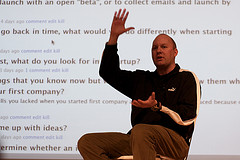
 With the venture community abuzz over Netscape co-founder and serial entrepreneur Marc Andreessen's new venture fund, I happened to fortuitously stumble upon Marc's personal blog. I'm glad I did, because I discovered the best collection of career advice that I've ever read. Marc's advice should be printed, bound, and placed in the career development office of every university in the country. The "Pmarca Guide to Career Planning" is honest, insightful, and a must read for any entrepreneur, undergraduate, pre-MBA, or MBA student.
I've done my best to distill Marc's "Pmarca Guide to Career Planning" down to its golden nuggets, along with my personal takeaways. Marc's original articles are linked from each section.
How to Approach Your Career
(Original Pmarca article: Part 1, Opportunity)Part 1 of the "Pmarca Guide to Career Planning" presents an opportunity-oriented mindset from which to evaluate and take action on your career.
Favorite Quote: "The world is a very malleable place. If you know what you want, and you go for it with maximum energy and drive and passion, the world will often reconfigure itself around you much more quickly and easily than you would think."
Key Points:
- Don't plan your career, instead plan to take advantage of opportunities as they arise or you create them.
- Great opportunities are rare. When a great opportunity finds you, count yourself lucky and jump on it. Do not let it pass you by just because it is different or risky.
- Have the energy and drive to create your own opportunities. The world will adjust to your ambition.
- Listen to your gut. If you don't like what you are doing, look for something else. If you see an opportunity to do something you think you'd love, DO IT!
- Jobs are like investments. They have a potential return and a specific risk profile.
- Know the amount of risk you can handle at a given point in your life.
- Taking a risk is a good thing, especially when it is tied to a great opportunity.
- Taking the "safe" career path of working for a big company can be riskier than you think due to the threat of layoffs and the danger of pigeonholing yourself into a skillset that is only useful at other big companies.
- Understand the opportunity cost of your decisions. Every decision to pursue one opportunity is a decision NOT to pursue another opportunity.
Personal Takeaway: As Wayne Gretzky said, "You miss 100% of the shots you don't take." Early in my consulting career I didn't take a lot of shots. I worked hard and hoped my hard work was noticed. It wasn't until I started being proactive in seeking out new projects, relationships, and leadership roles that things started to pick up big time. I found better projects, was promoted early, got into bschool, became a leader of the MIT $100K, and secured an awesome summer internship. Some of these opportunities were risky, stressful, or completely overwhelming, but the returns were invaluable.
Where and What to Study
(Original Pmarca article: Part 2, Skills and Education)Part 2 of the "Pmarca Guide to Career Planning" tackles some controversial topics around where to go to school, what to study, and what skills to acquire.
Favorite Quotes: "Graduating with a technical degree is like heading out into the real world armed with an assault rifle instead of a dull knife"
"Get into the real world and really challenge yourself -- expose yourself to risk -- put yourself in situations where you will succeed or fail by your own decisions and actions, and where that success or failure will be highly visible."
Key Points:
- Pick a practical major that is useful in the real world. Engineering, hard science (chemistry, biology, physics), economics, math, or computer science are good. Liberal arts degrees are useless if you want to have an impact in the real world.
- Graduate degrees are unnecessary if you have a practical undergrad degree.
- If you don't have a practical major, get a graduate degree in something substantive (business, economics, hard science).
- Go to the best school you can. Don't worry about being a small fish in a big pond. Get in the best pond possible and surround yourself with the best fish. This will yield the best opportunities.
- Get practical experience while you are in school. Get a term-time job. Pursue internships and co-ops. Real world experience will be invaluable during your job search.
- Learn communication, management, sales, finance, and international cultures.
- If you are young (in college or recent grad), from an upper class or upper middle class background, and especially if you are at a top-tier school, you have probably never really challenged yourself. You have worked hard, but you have led an orchestrated existence free from failure. You need to fail ASAP. You need to botch a project, be screamed at by your boss, or even be fired. And when that happens, you need to pick yourself back up and keep on going.
Personal Takeaway: I had a hard time with this section, mainly because it rang so true. It is slightly insulting when someone calls your undergraduate degree a "dull knife" or accuses you of living an "orchestrated existence" but I think Marc is right on-the-money. I studied History in college because I had a romantic notion that college should be spent on intellectual pursuits. History didn't help me get a job. History didn't help me get into bschool. In truth, I barely remember any of the dates, wars, movements, or theories I studied. Entering the workforce was like a cold shower - I had never actually created anything of value to the real world and didn't really know how to go about doing it. So, I learned the hard way - by failing. Some memorable failures included botching a presentation to a client's CIO and getting screamed at for missing a project deadline. Learning to recover from these failures were some of the most challenging and rewarding experiences of my career.
Where to Work
(Original Pmarca article: Part 3, Where to Go and Why)Part 3 of the "Pmarca Guide to Career Planning" provides advice on how to pick the right industry, company, and city.
Favorite Quote: "As an industry ages, the vitality drains out until all that's left is a set of ossified remnants in the form of oligopolostic entities of which you would find being a part to be completely soul-killing."
Key Points:
- If you want to have an impactful career, pick an industry that is young, growing, and rapidly changing.
- You know an industry is young when the founders of its key companies are still alive and actively involved.
- Sometimes old industries have become so old and out of touch that there are fantastic opportunities to reinvent them with new companies and new practices.
- Be at the center of your industry. Do this by working for the best company in the industry or starting a company focused on the biggest opportunity in the industry.
- Be at the geographic center of your industry. Live in the city where there are the most compelling opportunities for your industry. Examples: technology in Silicon Valley, politics in DC, entertainment in LA, financial services in NYC.
- There is a tradeoff between the current importance of a company or city and the impact you can make in a company or city. This is the tradeoff between an established industry leader and an emerging startup, or between an established industry center and the potential for international expansion.
- Working for a young high-growth company is the best way to get experience. You will do more stuff, get promoted quickly, get used to an environment where change is the only constant, and hopefully have a game-changing company on your resume. Marc points out that having Netscape from the early 90s, eBay from the late 90s, or Google from the early 00s on your resume is a career maker and easily as valuable as an advanced degree.
- Don't go to a young high-growth company just to bail when the company hits a bump in the road. Learn from the hard parts and then don't make the same mistakes when you are in the same position.
- Once you've cut your teeth at a young high-growth company, go to an early stage startup or start your own company. Be the next young, high-growth, industry changing company!
Personal Takeaway: I would argue that consulting is also a good way to kick off your career. You will learn a lot, do a lot of stuff, get promoted quickly, and build a great network. But, a word of caution, consulting is still not quite like the real world. While you may create something valuable during your project/case/engagement with a client, at the end of the day you will leave that client (and whatever you created) behind. I'm not sure that you can have a real, tangible, meaningful impact on an industry as a career consultant... but that is a topic for another blog post.
Let me know if you found Marc Andreessen's "Pmarca Guide to Career Planning" and/or my take on it helpful. Even though I'm not sure that I would have had the foresight to listen to it, this sort of advice would have been incredibly helpful as went through college and then embarked on my career.


